The two aspects of our environment most invoked when we talk about holding the environment clean are litter and water pollution. We will discuss both in this article.
Litter
About Global Warming Essay Best Buy
Litter is ugly and it can harm population and wildlife. Picking up litter can be costly for cities and highway departments.
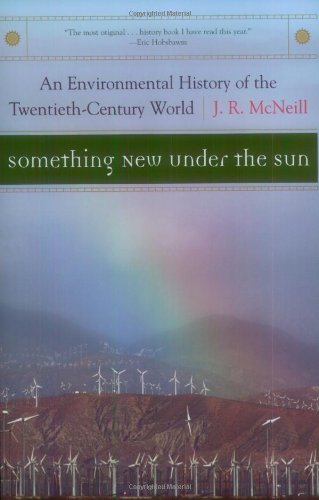
Something New Under the Sun: An Environmental History of the Twentieth-Century World (Global Century Series) Best
Rate This Product :


Something New Under the Sun: An Environmental History of the Twentieth-Century World (Global Century Series) Overview
"Refreshingly unpolemical and at times even witty, McNeill's book brims with carefully sifted statistics and brilliant details."—Washington Post Book World
The history of the twentieth century is most often told through its world wars, the rise and fall of communism, or its economic upheavals. In his startling new book, J. R. McNeill gives us our first general account of what may prove to be the most significant dimension of the twentieth century: its environmental history. To a degree unprecedented in human history, we have refashioned the earth's air, water, and soil, and the biosphere of which we are a part. Based on exhaustive research, McNeill's story—a compelling blend of anecdotes, data, and shrewd analysis—never preaches: it is our definitive account. This is a volume in The Global Century Series (general editor, Paul Kennedy). 40 b/w photographs, 15 mapsSomething New Under the Sun: An Environmental History of the Twentieth-Century World (Global Century Series) Specifications
J.R. McNeill, a professor of history at Georgetown University, visits the annals of the past century only to return to the present with bad news: in that 100-year span, he writes, the industrialized and developing nations of the world have wrought damage to nearly every part of the globe. That much seems obvious to even the most casual reader, but what emerges, and forcefully, from McNeill's pages is just how extensive that damage has been. For example, he writes, "soil degradation in one form or another now affects one-third of the world's land surface," larger by far than the world's cultivated areas. Things are worse in some places than in others; McNeill observes that Africa is "the only continent where food production per capita declined after 1960," due to the loss of productive soil. McNeill's litany continues: the air in most of the world's cities is perilously unhealthy; the drinking water across much of the planet is growing ever more polluted; the human species is increasingly locked "in a rigid and uneasy bond with modern agriculture," which trades the promise of abundant food for the use of carcinogenic pesticides and fossil fuels.The environmental changes of the last century, McNeill closes by saying, are on an unprecedented scale, so much so that we can scarcely begin to fathom their implications. We can, however, start to think about them, and McNeill's book is a helpful primer. --Gregory McNamee


Customer Reviews
*** Product Information and Prices Stored: Mar 14, 2012 05:32:19
Dog fouling in group places (another form of litter) is a serious condition risk, particularly for young children.
Cigarette butts are other unpleasant form of litter. They may seem small, but with several trillion butts littered every year they are the estimate one source of litter in this county. Cigarette butts make up a large part of much urban litter and they can take up to 12 years to break down.
So how do we keep litter off our group places and keep the environment clean?
The reply is, of course, firstly educate the group to take their litter home, and when they do not, it is essential to ensure that efficient street cleaning is provided.
Street cleaning is controlled by the agency of group Works in all towns and cities and is normally removed by appointed contractors or the Council's own direct labor force. When it works well you will normally find that the local businesses take an active interest in assisting in streamlining the process with also making further regular consultation with the community. street cleaning is often, but not always, carried out for extended hours, and these hours may range from 8 am until 12 or 2 pm in our big cities. street cleaning is an absolute necessity in all modern well run cities.
Street cleansing is a manual task and labor is a essential cost. Pleasure with the cleanliness of streets and industrial areas has improved in the Uk since privatization. One hypothesize likely for this is that previously the Council's staff had to be the policemen ensuring the efficiency of their own work. Human nature is such that to be on both sides of such a role seldom works efficiently.
Street cleansing is only a part of city housekeeping which in this report is just a part of how to keep the environment clean. The council (municipal) condition department's firm is to see that all the population have pure air, pure water, pure food, and are protected from contagious diseases.
Street cleaning is an foremost element of city housekeeping and is in case,granted more and more by highly mechanized equipment such as through the use of street sweepers and flushers. Most streets are scheduled for cleaning at least five times per year, and paved alleys are cleaned once.
Street cleaning must all the time be strictly enforced, and react to events when litter will build up more quickly, but without clean water in the rivers and streams throughout the city the municipal authorities could hardly be said to be holding the environment clean.
River Pollution
The avoidance of river pollution is if anything more essential than street cleansing, especially where the poorer population must rely on the river water for domestic and even drinking water use.
If asked how to keep the environment clean from river pollution we would have to say by collecting all sewage and treating it before allowing it to discharge back into the river downstream.
River pollution is the most devastative phenomena to condition in the poor and developing. Pollution is occurring when the water shows an alteration of physical and chemical parameters such as odor, taste, colour, turbidity.
If polluted water is tested in a water potential diagnosis laboratory there are a estimate of tell-tale changes you will notice. These are exemplified by changes in total hardness, pH, chlorides etc. Expect to see Bod, and Cod in increased quantities as well, among others.
River pollution is a serious problem. In modern years there has been a growing awareness of the issues complicated but, at the same time, continued urbanization and industrialization and the continued increase of population produce ever-increasing amounts of waste for disposal.
Dangerously, River pollution is concentrated colse to urban areas. River Pollution is a major environmental qoute today, but we don't seem to be making as much progress as we should. Possibly the hypothesize is ideological?
Where sewage medicine plants have been installed the levels of indicator bacteria and nitrogen in the discharge should be tracked to portion administration performance. If a failure in discharge potential occurs the municipal authorities must act to conclude changes needed in monitoring protocol to avoid any further occurrences. It is foremost to also report progress and recommendations to advise planning and administration decision-makers. Levels of any pollutant can be measured by water potential testing methods, and once the diagnosis has been in case,granted it is all the time foremost to check the data thought about against the legal standards. For example, the State of Florida sets the safe condition accepted for bacteria as less than 1000 faecal coliform bacteria per 100 milliliters.
The most base sources of pollution are domestic water discharges from the houses in the catchment area, and uncontrolled dumps of solid domestic wastes along tributary banks and in dry ravines. industrial discharge can be a major cause of pollution. Each industrial discharge normally contains chemicals and organic compounds which can enter the bodies of many aquatic animals. Even ground water can be polluted from the soakage pits, septic tanks, manure, garbage, etc. And that ultimately discharges to the rivers still worsening the problem.
Industrial pollutants from smaller units continue to be a problem. While most of the large and medium industrial units have put up medicine plants and are using them. 40 per cent of the industrial waste seen in one example - a whopping 4000 mld - is from small scale industries in cities and residential colonies.
How to Keep the Environment CleanThe Process of Service-Learning: Meeting National Priorities and Improving Results Video Clips. Duration : 62.72 Mins.During this one-hour webinar, take a tour of the revised second edition of The Complete Guide to Service Learning: Proven, Practical Ways to Engage Students in Civic Responsibility, Academic Curriculum & Social Action with author and international service-learning expert Cathryn Berger Kaye. Her guidance will provide you time-saving insights and tools, show you extensive resources that maximize academic connections, increase youth voice, add meaning and purpose, develop reciprocal benefits with your partners, and bring learning to life! As you address the national focus areas, dive into the National Learn & Serve Challenge, work toward a Semester of Service, or ensure that your service-learning integrates critical thinking, skill development, and well-integrated curriculum, this webinar is for you!
Keywords: service learning, national priorities

No comments:
Post a Comment