Water pollution refers to the changes in the physical, biological, and chemical conditions of any body of water which harmfully disrupts the equilibrium of the ecosystem.
Like any type of pollution, water pollution results when an astounding amount of waste arrival from different sources of pollutants can no longer be accommodated by the natural ecosystem. Consequently, when the wastes are not destroyed as fast as they are produced, they make it unfavorable to humans and many other organisms. But that's not all. Learn more about what causes water pollution.
About Global Warming Essay Best Buy
There are verily many exact reasons behind what causes water pollution. However, it is leading to acquaint yourself with the two main categories of water pollution. Some pollution comes directly from one's exact location. This type of pollution is called point source pollution such as sewage pipes that empty polluted water into the river and farmland. Meanwhile, non-point source pollution is pollution that comes from large areas like gasoline and other dirt from highways that go into the lakes and rivers.
The Assault on Reason Best

Rate This Product :


The Assault on Reason Overview
At the time George W. Bush ordered American forces to invade Iraq, 70 percent of Americans believed Saddam Hussein was linked to 9/11. Voters in Ohio, when asked by pollsters to list what stuck in their minds about the campaign, most frequently named two Bush television ads that played to fears of terrorism.
We live in an age when the thirty-second television spot is the most powerful force shaping the electorate's thinking, and America is in the hands of an administration less interested than any previous administration in sharing the truth with the citizenry. Related to this and of even greater concern is this administration's disinterest in the process by which the truth is ascertained, the tenets of fact-based reasoning-first among them an embrace of open inquiry in which unexpected and even inconvenient facts can lead to unexpected conclusions.
How did we get here? How much damage has been done to the functioning of our democracy and its role as steward of our security? Never has there been a worse time for us to lose the capacity to face the reality of our long-term challenges, from national security to the economy, from issues of health and social welfare to the environment. As The Assault on Reason shows us, we have precious little time to waste.
Gore's larger goal in this book is to explain how the public sphere itself has evolved into a place hospitable to reason's enemies, to make us more aware of the forces at work on our own minds, and to lead us to an understanding of what we can do, individually and collectively, to restore the rule of reason and safeguard our future. Drawing on a life's work in politics as well as on the work of experts across a broad range of disciplines, Al Gore has written a farsighted and powerful manifesto for clear thinking.
The Assault on Reason Specifications
The first question many people ask when hearing of a new book from Al Gore is, "Is it about the environment?" The answer is yes, but it's not (or, rather, not only) the kind of environment he wrote about in Earth in the Balance and of course painted such a vivid picture of in his Oscar-winning documentary (and companion book), An Inconvenient Truth. It's the political environment he's concerned about in The Assault on Reason: the way we debate and decide on the critical issues of the day. In an account that balances theoretical discussion of the foundations of democracy with a lacerating critique of the Bush administration, Gore argues that the marketplace of reasoned debate our country was founded on is being endangered by a variety of allied forces: the use of fear and the misuse of faith, the distractions of our entertainment culture, and the concentrations of power in the national media and the executive branch. In his essay and answers to our questions below, he introduces the crisis he sees, as well as the opportunity for its solution he envisions in the open forums of the Internet.A Message from Al Gore to Amazon.com Readers
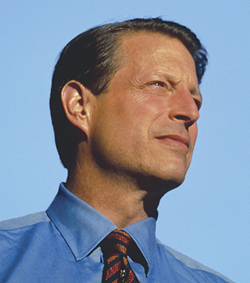 I've dedicated my book, The Assault on Reason, to my father, Senator Albert Gore Sr., the bravest politician I've ever known. In the 1970 mid-term elections, President Richard Nixon relied on a campaign of fear to consolidate his power. I was in the military at the time, on my way to Vietnam as an army journalist, and I watched as my father was accused of being unpatriotic because he was steadfast in his opposition to the War--and as he was labeled an atheist because he dared to oppose a constitutional amendment to foster government-sponsored prayer in the public schools. The 1970 campaign is now regarded by political historians as a watershed, marking a sharp decline in the tone of our national discourse--a decline that has only worsened in recent years as fear has become a more powerful political tool than trust, public consumption of entertainment has dramatically surpassed that of serious news, and blind faith has proven more potent than truth.
We are at a pivotal moment in American democracy. The persistent and sustained reliance on falsehoods as the basis of policy, even in the face of evidence to the contrary, has reached levels that were previously unimaginable. It's too easy and too partisan to simply place the blame on the policies of President George W. Bush. We are all responsible for the decisions our country makes.
Reasoned, focused discourse is vital to our democracy to ensure a well-informed citizenry. But this is difficult in an environment in which we are experiencing a new pattern of serial obsessions that periodically take over the airwaves for weeks at a time--from the O.J. Simpson and Michael Jackson trials to Paris Hilton and Anna Nicole Smith.
Never has it been more vital for us to face the reality of our long-term challenges, from the climate crisis to the war in Iraq to the deficits and health and social welfare. Today, reason is under assault by forces using sophisticated techniques such as propaganda, psychology, and electronic mass media. Yet, democracy's advocates are beginning to use their own sophisticated techniques: the Internet, online organizing, blogs, and wikis. Although the challenges we face are great, I am more confident than ever before that democracy will prevail and that the American people are rising to the challenge of reinvigorating self-government. It is my great hope that those who read my book will choose to become part of a new movement to rekindle the true spirit of America.
Questions for Al Gore
Amazon.com:Of all I've read and seen on climate change, I don't think anything has had quite the impact on me that those vivid maps of shrinking coastlines did in An Inconvenient Truth. You've spent years trying to communicate the threat of climate change and you've learned how to use compelling images to tell that story, but in this book you're very wary of the power of visual images to overwhelm reason with fear. How do you spur people to action in a crisis like this without using fear?
Gore: I often open the slideshow by talking about the "climate crisis." The English meaning of the word "crisis" conveys alarm, but the Chinese and Japanese expressions use two characters together: the first means danger, but the second means opportunity. The animations do help to convey some of that sense of danger--but the opportunities are enormous. We are beginning to see companies taking advantage of the new markets that are emerging as they innovate and put to market the technologies that we need to solve this crisis. Some have become ubiquitous, like the hybrid electric engine and compact fluorescent light bulb. There are thousands of opportunities like this all around us if governments will show the type of bold leadership that we need--and work with industry to exploit these opportunities.
Amazon.com: You describe two problems with television culture: it's a top-down system in which, as you say, "Individuals receive, but they cannot send," and its physiological vividness allows it to bypass our reason. The user-created communities that seem so promising on the Internet would seem to solve the first problem, but what about the second?
Gore: There are a number of barriers for individuals who want to communicate over TV. The major networks won't give average Americans a voice, and it is virtually impossible to start a channel. One solution, that I have worked on with my partner, Joel Hyatt, is the creation of Current TV, where viewers can submit content over the Internet to air on the channel.
With regards to the Internet, anyone with access to a computer and broadband can create a website or blog and post content. They can send information into the public forum. Of course, we need to continue to work to bridge the digital divide, to ensure that we expand the access of people to the Internet, but the threshold for entry is much lower than that of television.
Amazon.com: You're the chairman of Current TV, the interactive cable channel aimed at young people. Can you talk about the challenges of constructing a platform where the kind of substantive dialogue you are looking for can take place?
Gore: One of the things I talk about in the book is infotainment--the "well-amused" audience that is bombarded with the latest programming about O.J. Simpson, or JonBenet Ramsey, or Anna Nicole Smith. What we are trying to do, in part, is to provide a public forum for viewers to submit content about issues of concern to them. And they have, by the thousands, on issues from the war in Iraq to the environment to education and others. I am continually amazed by both the quality of the submissions and the breadth and depth of the subject matter.
Amazon.com: You have a chapter on the importance of checks and balances in government (in a sense, that's what the whole book is about), and we're seeing the effect that active oversight from Congress is having right now. For most of your eight years in office, you and Bill Clinton had to work with a Republican Congress. I'm sure that at times (say, 1998) that had its frustrations, but do you think it was valuable to have that balance, or did it prevent you from doing what you came into office to do?
Gore: Checks and balances are vital to the functioning of our system of government. Of course it can have its frustrations, but the Founders intended that we have a system whereby no one branch has too much control over the others. Ultimately, it is up to voters to decide the control of Congress and the White House and then for elected officials to work to serve the public interest and to try to implement policies that serve the country. These are core values that are at the heart of who we are as a nation.
Amazon.com: I wanted to ask about the Office of the Vice President. I think it's safe to say that the last two vice presidents, you and Dick Cheney, have been the most powerful and influential in our history. Why do you think that is?
Gore: I think the answer is very different in the two administrations, but in a world that is truly globalized, with a broader information ecology, with challenges ranging from a more complex system of international issues ranging from the climate crisis to asymmetric attacks, it is not a surprise that a President might choose to draw upon more advice from the office of the vice president than in the past. This is a trend that I would expect to continue under future presidents, as the range of the demands on the presidency will not diminish over time.


Customer Reviews
*** Product Information and Prices Stored: Mar 07, 2012 04:56:20
What are the causes water pollution? Who are the culprits who should be responsible for the harm brought by their pollutants? How do these sources of pollution pollute different bodies of water?
One major cause of water pollution that has caused serious environmental and health problems are the pollutants arrival from chemical and market processes. When factories and manufacturers pour their chemicals and livestock wastes directly into streams and rivers, the water becomes poisonous and oxygen levels are depleted causing many aquatic organisms to die. These wastes consist of solvents and toxic substances. Most of the wastes are not biodegradable. Power plants, paper mills, refineries, automobile factories dispose waste into the rivers.
The heated water from the power plants is called thermal pollution. This kills aquatic animals and plants by reducing the oxygen article of the water. Power plants use water to cool their machineries, thus changing the climatic characteristic of the water.
Aside from thermal pollution, there are also organic and inorganic pollutants. The organic wastes consist of refuse from slaughter houses, fish and meat canning factories, and leather tanning companies, manufacturing plants, pesticides and crude oil companies. Since organic wastes are decomposed by microorganisms, much of the dissolved oxygen in water is used up and the waster begins to stink.
Inorganic wastes consist of toxic and corrosive substances like acids, heavy metals, mercury, cadmium and lead which can impair the general body processes. Battery manufacturers, mining, paper mills growth the attention of mercury development the water perilous and poisonous for most living things.
Another cause of water pollution is from pesticides. Farm pesticides poison aquatic plants and animals. Animal manure, chemical fertilizers, phosphate detergent pollute water by supplying excess nutrients. This pollution is known as eutrophication. This greatly increases the growth of algae in water thereby decreasing the amount of oxygen level in water causing the death of many aquatic organisms.
Water is also being polluted by garbage specifically plastics and other plastic-like substances. Some plastic like nylon can entangle fishes and other marine animals. Plastics that have broken down into tiny pieces can be eaten by sea creatures which may cause their death. Since plastic is non-biodegradable, it will continue to kill more fishes.
One more cause of water pollution is sewage arrival from households. Since no one wants to live in a polluted area, near a dumpsite or landfill, the wastewater and untreated sewage are carried away from the home polluting different bodies of water. Most developing countries institution this type of sewage disposal. Even modern countries carry poorly treated sewage to canals leading to major bodies of water. The danger is when the sewage pipes gets broken and waste contaminates the drinking water. When this happens, the breakage will open a wide array of water borne diseases that will verily pose peril to consumers.
Last among the causes of water pollution are personal care and household products. Shampoo, lotion, moisturizer, hair dye, bleach, laundry detergent, fabric softener, and many others conduce to water pollution. Human waste is not the only thing that goes to sewage. These products also join the wastewater to contaminate the streams, rivers, and lakes.
Although the world abounds with water, only three percent of it is potable. Included in the 3% source of potable water are the streams, spring, rivers, lakes, and waterfalls that are continuously being threatened and contaminated by the different factors that cause of water pollution. If the sources of water pollution are not controlled, this basic necessity will at last become a rare commodity only a few can afford to have.
What is the Cause of Water Pollution?In the Company of Big Animals Video Clips. Duration : 61.63 Mins.Google Tech Talk October 5, 2010 Presented by Amos Nachoum. ABSTRACT BBC Wildlife Photographer of the Year Amos Nachoum talks about making photographs of large undersea animals. About the speaker: Amos Nachoum is a wildlife photographer and explorer. He has shot just about everything there is to shoot, war, journalism, fashion, racing of cars and Motorcycles...but what he loves most is wildlife photography. Especially if it's in the water. And he has become world-famous at it. So much so, in fact, that he has been asked to lead National Geographic expedition teams with Dr. Eugenie Clark, Dr. Sylvia Earle, and astronaut Buzz Aldrin. He has co-produced documentaries with Stan Waterman, and he was the team leader for National Geographic's Red Sea, Great White Shark, and Killer Whale photo expeditions. His commitment to wildlife led him to co-found Israel's Marine National Park on the Red Sea. He works tirelessly to bring attention to some of the most fragile regions of the underwater realm, with preservation of the environment foremost in every encounter. Amos's photos and essays have appeared in hundreds of publications around the globe, including National Geographic, Time, Life, The New York Times, Condé Nast Traveler, Le Figaro, Terra Sauvage, Airone, Mondo Somerso, Der Spiegel, Unterwasser, and many more. His work has also been included in the books The Living Ocean, The World of Nature, and Oceans. He has been profiled in television appearances on National Geographic ...
Tags: google tech talk, photography, sharks, whales, nature photography, marine life

No comments:
Post a Comment